I’ve been very frustrated with my process of how I pick up new skills recently; finally bit the bullet and enrolled for the @LHTL_MOOC.
So far the only thing I know about myself and how I learn is that I’m a social learner (hence this public accountability).
I’m surprised by how small the course is. About 12h of content, of which about 2h is reading, spread out over 4 weeks. Decided to finally take it.
A new batch starts today. ;)
Just did the first ten minutes of the course and I really like the concept of ‘focused learning’ and ‘diffused learning’.
Makes all the “After 5h on a bug, i took a break and solved it in two minutes” stories so much more believable
Another thing I really like is that everything the course says is the results of decades of study; makes me feel really good about not supporting random pseudoscience (Teach your child 100 percent Memory Retention techniques in just 10 days!)
I also love @barbaraoakley ‘s voice and intonation! Or maybe it’s the fact that it’s nearly 2am and I have work tomorrow but I’m so very relaxed after listening to her on the videos ❤️
Back again looking at this. It seems that both Salvador Dali, surrealist painter of repute, and Thomas Edison, master inventor, would both let their minds wander until almost a state of sleep. They would hold in their hands a bunch of keys or some ball bearings which would drop
on the floor when they were almost asleep and then jerk them awake. Then they would collect all the thoughts they had had in their ‘diffuse’ state and get to work!
The course goes on to show the picture of a dendrite before learning, and after learning with a good night’s sleep. They almost look like different dendrites! Then they talk about how sleep activates quite a few resting areas that aren’t touched by your focus mode but this
resting/diffuse state is when the learning paths and patterns are strengthened.
Every time you get a good night’s sleep, your brain is basically getting an upgrade. That is so cool.
Note to self: fix sleep issues asap
All this also begs the question - if the landscape of the brain is changing so fast, where are long term memories stored?
Day 3, and the video starts off by saying “Everyone has problems with procrastination…” which is so great to hear from someone else’s mouth! (Begone, ye pesky imposter syndrome!)
Turns out the REASON we procrastinate is that when have to do something we don’t want to, centers in the brain associated with pain are activated. To distract ourselves from the pain, we are inclined to do something that gives us temporary happiness.
(this means that my technique of covering up period cramps with binge watching/reading/listening has been Scientifically Approved and all the aunties insisting I should sleep can find someone else to harass)
BUT scientists also found that once you start doing the task, your pain center is slowly deactivated and you actually start enjoying it.
So how do we get past the initial hurdle?
The pomodoro technique.
Yes I know you’ve been told this time and again but it hasn’t worked and that’s so frustrating. But we’ve been doing pomodoro all wrong. Hear me out.
Use the pomodoro technique to:
Start doing something you’ve been dreading
Singular focus on a one thing
reward yourself at the end with something very small but very pleasant
Don’t
use it to fix focus issues
use it all the time.
It’s meant to be a launch pad.
Day 4.
The reason math and science might seem more challenging than other subjects is because it is filled with abstract ideas - you can’t point to a plus sign standing in a field and explain it the way you can the working of a car engine, for example.
Abstract ideas are harder to understand instinctively, and therefore the neural pathways they create are fainter as well. This means that for a single abstract idea to take root you will have to practice the same thought process a lot more.
That’s why ‘reading’ math never works
When were learning things, we are accessing memory. We have two major sorts:
Working Memory, which only holds the things that you are actively thinking about, and
Long Term memory, which is the sum of everything else that we remember.
Working memory is located in the pre-frontal cortex, and occupies about a third of our brain. Research shows that we can actively hold at most 4 ‘chunks’ of information in our head at any given time, which is why, if we want to remember something, we might close our eyes.
WM is like a black card with limited space, but it’s not a very good one. Things are constantly being overwritten by new stimuli, which is why if we want to remember a date, or a name, for example, we need to repeat it a few times - until it moves into long term memory
Long term memory occupies the rest of our brain, and can hold millions and millions of items. The transaction is made into the long term brain by a technique called ‘spaced out repetition’
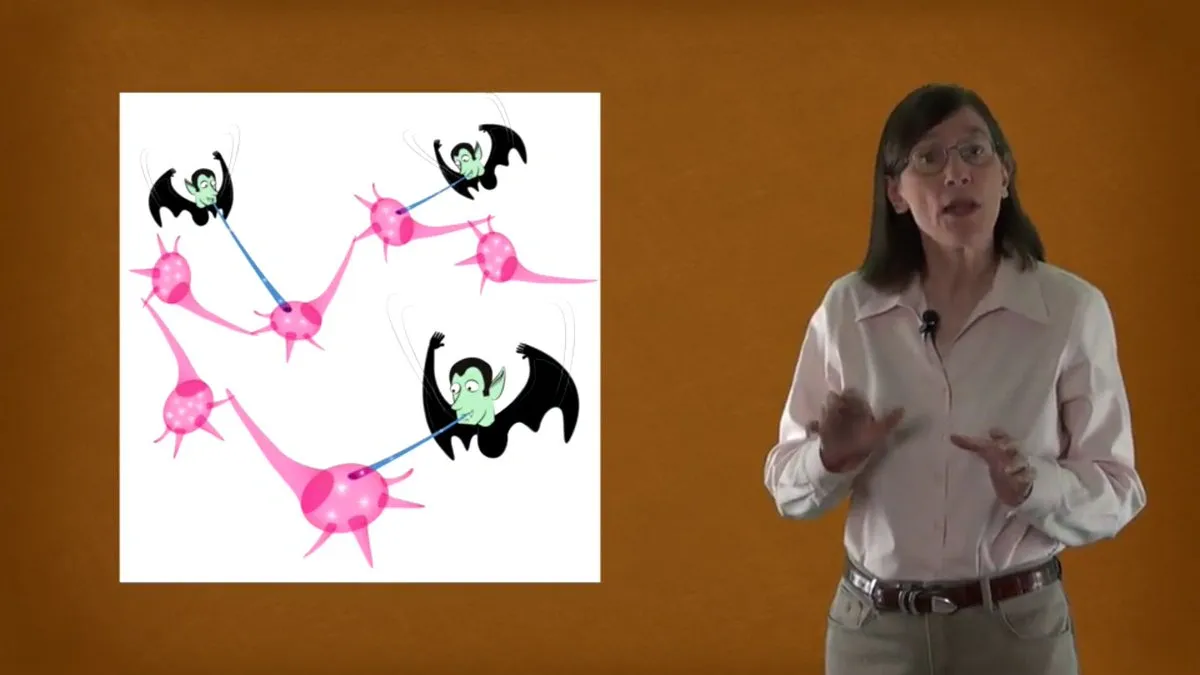
(Otherwise synapse vampires suck the brain connections away!)
Note to self - go through this entire thread again in two days.
The next video is ‘effect of sleep on long-term learning’ and I am going to feel so guilty now
Guess who has two thumbs and no time to follow up on this course?
In my defense though, I attended a very amazing conference, met great new people, planned a Meetup, attended a meetup, and wrote about 4 college tests.
In the last 6 days.
Not too bad, if I do say so myself.
But I have a commute ahead of me, so here we go again.
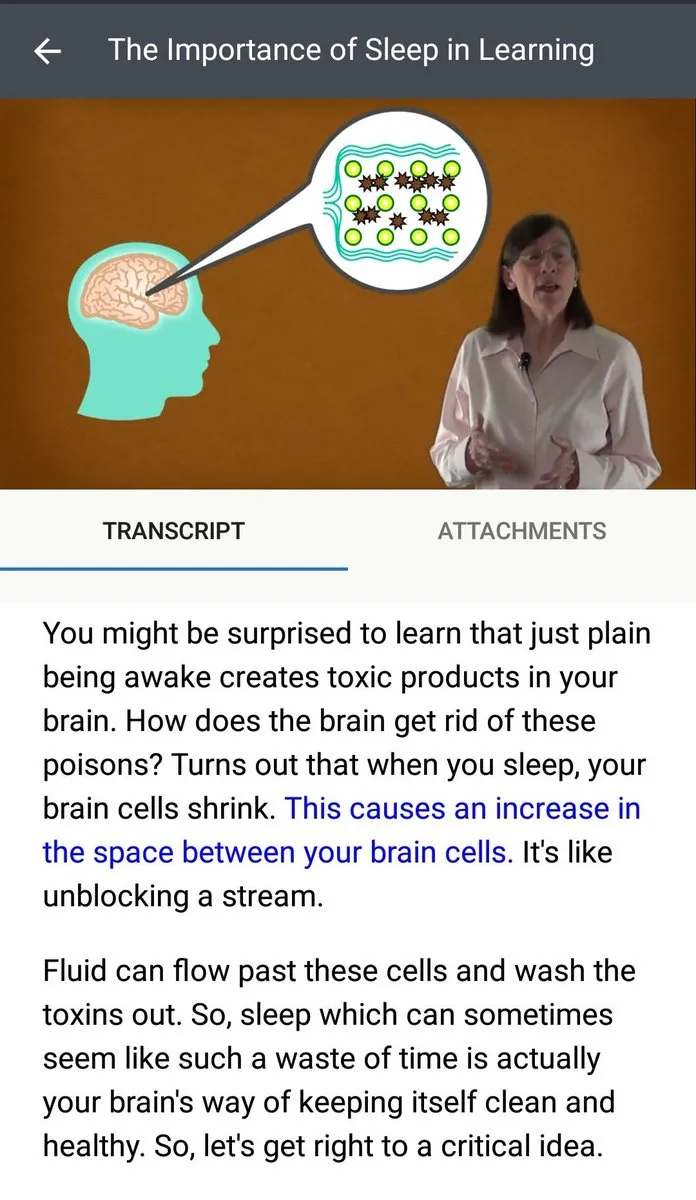
So when we’re awake we’re constantly producing toxins that litter are brain. And when we sleep? Our brain is literally cleaning house. How it does that is pretty neat, see image.
This means that if we’re taking a test or driving on very little sleep, our brain is literally not performing in an ideal state.
Also, this behavior, like most other bodily functions, is programmed over the course of years and years.
Which means of course that is not followed adequetely can lead to years and years of health issues.
The case for much higher respect and pay for people working night shifts, variable timing jobs, or change timezones a lot of very high.
When you’re asleep, your brain is also constantly going over the patterns you created with thoughts that day, willing away weak ones and strengthening strong ones. (Is this where dreams come from?)
This is why the solution seems obvious to you when you wake up from a nap.
(the brain is able to do this only when asleep because that’s when the pre-frontal cortex, or the ‘RAM’ is completely suspended. So fascinating.)
We’re talking to someone who has achieved major things in academia now.
learning by doing
osmosis of being around people who are really good at that one particular field
in a ‘boring’ lecture/talk, engage with the speaker (brain also responds better to active engagement as opposed to passive listening)
when doing physical work brain is in diffuse mode. This is why exercise is great. Carry notebook around.
So you’re born with a set number of neurons in your brain, and you die with lesser, because some of them die.
The only thing that allows you to produce more neurons is the simulation of the hippocampus, which happens via:
an enriched environment: this is lots of noise and
movement and different people and things all day, or
exercise
I really really need to start putting my running shoes on.
Exercise, in the absence of an enriched environment, will provide the same conditions that promote the growth of neurons in the hippocampus.
This is incredibly important to consider in the landscape our current educational policies.
Everytime schools have to make space for a new activity, what do they do? Axe the PT period.
The amt of times this has happened in my brother’s skl alone is so depressing. I wish there was a helpline we could call and complain to, or a campaign we could run to make this happen.
how to be creative better: having soundboards and someone to talk to has been critical.
Something I’ve found very important in my own professional life as well.
test taking is a skill, you can learn it (by practice)
Creativity in the face of routine: surround yourself
with different (fresh) perspectives
Success != Smart
Success == passion, persistence.
And we’re done.
FOLKS. WE’RE DONE WITH THE FIRST MODULE oh finally I took two weeks to do what was suggested for one but it’s okay. Things are hectic and I’m still glad that I’ve been persistent about this. Now to do the assignments and everything else this evening. :)
I have actually made time for this course now, and I can’t wait to go back!
These notes came in super useful just now, and I need to do it more.
I am also going to be doing the Honors version of this course so the first thing I have to do is write a reflective essay.
This essay will talk about:
My current learning career and trajectory
The learning aim that is of importance to me
Biggest mental challenges in achieving my aim
Outline existing research or learning techniques to fix this
This is the first time I’ve had to do any sort of real research when submitting a paper. It was fun! and hard. I don’t really think I did it right, though. Can’t wait to do more.
I started this in 2018, wrote an essay in 2019, then gave up completely. baby tanvi did NOT know how to learn.
I’ve been daily-driving LLMs for 15 months now. One thing is clear - I need to be able to skim, intuit, absorb, retain, and retrieve more superlatively than ever
What I’ve attempted so far: spent several hours doing exhaustive review of my total body of technical knowledge, set up a hermes agent to pick a thing and talk to me about it every day. Made sure to set up variety of topics, spaced repetition, hard and easy mode, etc
didn’t work because it still felt too mechanical and didn’t have enough context with what I was doing.
brute forcing the learning also didn’t work for obvious reasons.
I determined immediately after using llms that I caNNOT use them to replace writing for me
yes - writing is thinking! But I /can/ use llms as a research partner, or on the rare occasion that I care about an essay enough to clean up voice, increase readability etc.
Similarly, learning cannot be llm-driven. It has to be llm augmented. So I am back to this course.
so I can start from first principles! And friends, this time I cut myself a lot of slack.
I don’t need to sit down and pay attention to learn. I just got the app, put on the material as an audiobook while chorsing and off we went.
The following is recall of what’s important.
chunking is the concept that allows us to break down information and then intuit it. The point of a chunk is not to know details, it is to understand the concept ie move it from working memory to long term memory ie increase retrieval and applicability.
one increases the rate of chunking by
consistent learning in the form of spaced repetition
interleaving concepts that are related but not similar
using metaphors to relate to concepts you already know
(there is a craft to using metaphors tho! need to go deeper on this)
learning is not an independent thing that you can will into existence. your brain chemistry and your emotions significantly increases or decrease your ability to create these chunks and to store things in your long term memory.
acetylcholine controls your focus, and your synaptic plasticity.
Dopamine controls your ability to start any kind of habit forming activity.
Serotonin increases social bonds and reduces risk taking behaviour.
so it’s easier to form chunks (ie learn better) if your neurochemicals are in the right amounts and easily accessible.
As you get good at chunking, you can also chunk bigger things! ie learn MORE, which doesn’t mean you learn faster but does increase your rate of learning :)
when we learn, it’s important to focus on retrievability - that is the most important outcome.
so we need to train our brains to retrieve what we just learnt. The best way? recall!
this was surprising to me - its not rereading, or relating to other existing topics, etc.
So when you come across a new concept, think about what you need to retain - but look away from the screen.
tests are recall taken to an extreme (affectionate).
when you inevitably make mistakes with recall and testing, it will help you focus on the gaps in your understanding
if we’re preparing for testing tho, it is helpful to do the recall in different spaces. Otherwise, our environment becomes a cue to the recall and that breaks for centralised testing for which there is a destination.
depression affects your neurochemical brain in real tangible ways. It is okay to seek help, and it is okay to take medication for it if you feel like it will help. It helped me.